Asphalt Crack Sealing in Montérégie
RBQ 5624-8867-01
30+ years of experience
MTQ 14501 certified
What is asphalt crack sealing?
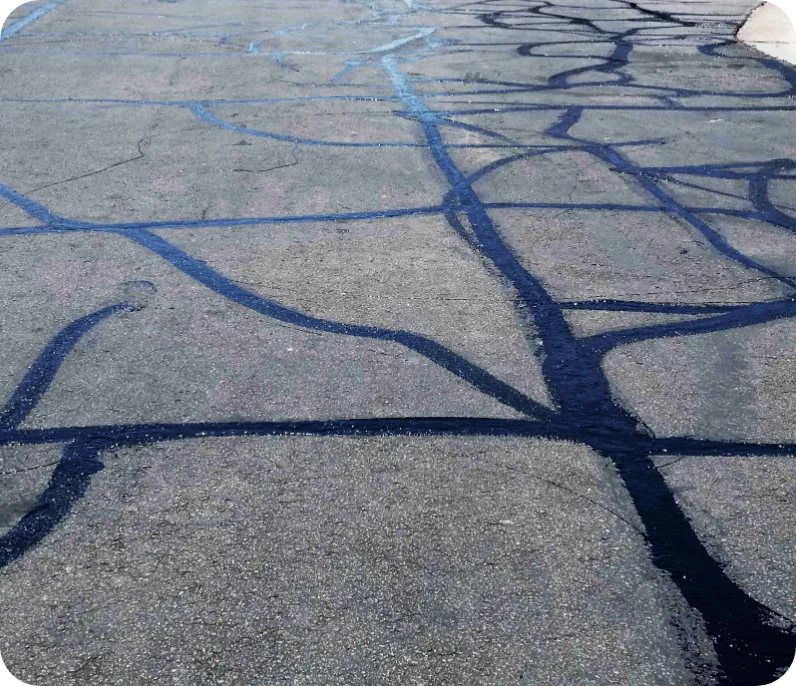
Asphalt crack sealing is a preventive maintenance procedure that involves filling cracks on the surface of a pavement with a flexible bituminous product, to prevent the infiltration of water, de-icing salt, and debris into the underlying layers. In Quebec’s harsh climate, where the freeze-thaw cycle stretches over more than five months a year, water that seeps into an untreated crack freezes, expands by approximately 9 %, and literally bursts the asphalt structure apart. This is how potholes, subsidence, and alligator cracking appear — ultimately ruining an entire parking lot.
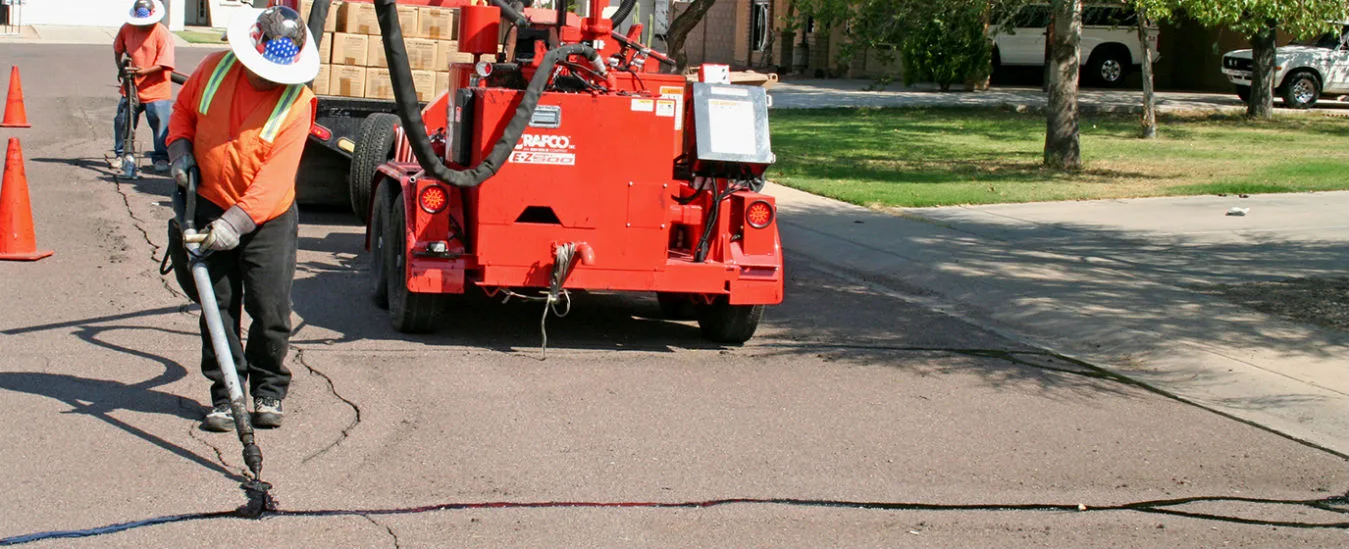
At L’Équipe Marcil, we exclusively practise hot-applied crack sealing, a method recognized by the Quebec Ministry of Transportation (MTQ standard 14501) and used throughout the provincial highway network. Properly applied, hot crack sealing can extend the useful life of your asphalt by three to five years for a fraction of the cost of a full repaving.
Our 5-step crack sealing process
A successful seal depends not only on the quality of the product: it relies just as much on the rigour of the preparation as on the application itself. Here is how we proceed on every job site in Montérégie and the South Shore of Montreal:
- Inspection and mapping. We walk the entire surface to be sealed, identify all cracks wider than 3 mm, measure their total length, and determine whether a simple seal is sufficient or whether certain areas require patching beforehand.
- High-pressure compressed air cleaning. We blow out each crack with an industrial compressor to eject all dust, sand, vegetation, and residual moisture. A poorly cleaned crack means a sealant that won’t bond — this is the step most often skipped by low-end contractors.
- Crack heating. We run a propane torch along the lips of the crack to evaporate all moisture and warm the substrate. A cold substrate creates a thermal barrier that prevents the sealant from mechanically bonding to the asphalt.
- Hot sealant application. We use a bitumen-polymer sealant heated to approximately 190 °C in a double-boiler melter. The product is applied by wand under controlled pressure so that it penetrates to the bottom of the crack and creates a plug of 5 to 10 mm at the surface.
- Finishing and return to traffic. We sprinkle a thin layer of mineral powder to prevent the sealant from sticking to tires in the first few minutes, then the parking lot is reopened to traffic in less than 30 minutes.
Hot or cold crack sealing: which one to choose?
Cold sealants in tubes or pails sold at hardware stores are tempting for a property owner, but they almost always turn out to be a poor investment over the medium term. Here is why.
Cold sealant is a fluid asphalt emulsion that dries by evaporation. It only fills the crack visually: it does not penetrate deeply, it hardens within a few months, and it cracks at the first freeze-thaw cycle. It needs to be redone every year, sometimes twice a year.
Hot sealant, on the other hand, is a thermoplastic material composed of bitumen, elastomeric polymers (SBS type), and stabilising agents. Once cooled, it remains flexible at -30 °C, 100 % waterproof, and capable of stretching with the movements of the crack without breaking. Its average service life in Quebec’s climate is between 3 and 7 years, depending on sun exposure, traffic intensity, and substrate quality.
For any surface larger than 50 m² or for any commercial use, hot crack sealing is the only economically sound option. It is also the only method accepted on public works job sites.
When should you seal your asphalt cracks?
The simple rule we give our clients: as soon as a crack reaches 3 mm in width, it must be sealed before the next winter. Below 3 mm, surface micro-cracks often self-resolve and do not justify an intervention. Above 20 mm, we are no longer talking about sealing but patching: the crack has become a crevice and needs to be filled with hot-mix asphalt before being sealed.
The ideal sealing season in Quebec runs from late May to mid-October, when the substrate is dry, warm, and nighttime temperatures do not drop below 10 °C. We avoid rainy or persistently dewy days, which compromise adhesion. If you are planning a sealing project, schedule it in the spring: after winter damage, that is when cracks are most visible and when the protective effect is greatest for the summer season.
How much does crack sealing cost in Montérégie?
Hot crack sealing is generally priced per linear ft of crack, with a minimum charge to cover equipment and personnel travel. The ranges we see in 2026 on the South Shore of Montreal and in Montérégie are as follows:
- Residential (driveway, 50–200 linear ft) : minimum site visit fee of approximately $250 to $400 for small jobs.
- Light commercial (small parking lot, 200–1,000 linear ft) : approximately $1.50 to $2.75 per linear ft, depending on accessibility and crack density.
- Heavy commercial and condominiums (>1,000 linear ft) : decreasing rates starting at $1.25 per linear ft, with an optional annual maintenance contract.
These ranges are indicative: every project is assessed in person, free of charge, before being quoted. Factors that affect the price include the distance from Sherrington, the need for patching, line painting or marking after sealing, and the time slot (night or weekend work for active commercial parking lots).
Frequently asked questions about crack sealing
How long does hot crack sealing last?
Between 3 and 7 years in Quebec’s climate, depending on sun exposure, traffic, and the quality of the underlying asphalt. A shaded residential parking lot can easily last 6 years between sealings.
Can traffic use the surface immediately after sealing?
Yes, after approximately 30 minutes to 1 hour depending on the ambient temperature. We sprinkle an anti-stick agent to allow immediate vehicle traffic without risk of transfer onto tires.
Does crack sealing fix potholes?
No. Potholes are the result of a crack that has been ignored for too long. They require repair by hot patching with bituminous hot mix, which can then be sealed at its perimeter to prevent the cycle from repeating.
Do you offer maintenance contracts for property managers?
Yes. We offer annual contracts for condominium boards, shopping centres, and industrial parks across the entire South Shore of Montreal. Annual inspection included and priority booking.
What is your service area?
We serve all of Montérégie and the South Shore of Montreal from our base in Sherrington: Napierville, Saint-Michel, Saint-Rémi, Saint-Jean-sur-Richelieu, Châteauguay, Chambly, La Prairie, Candiac, Brossard, Longueuil, and all surrounding municipalities.
Learn more
- Hot vs cold crack sealing: the complete 2026 guide — Understand why hot sealant is 3× more cost-effective over 10 years.
- Crack sealing prices in Quebec in 2026 — Real price ranges, 7 pricing factors, quote examples.
- Crafco 522 and the MTQ 14501 standard — Quebec’s reference sealant and why it lasts 5–7 years.
Free quote in 24h
Free on-site inspection and written estimate within 24 hours, anywhere in Montérégie.
Call us
Monday to Friday 7 AM – 5 PM
RBQ 5624-8867-01
Our crack sealing projects across Montérégie